
Reverse Osmosis

Reverse Osmosis
If you want better drinking water at the tap, reverse osmosis provides a higher level of filtration than standard carbon filtration alone. RO systems use water pressure to push water through a semipermeable membrane, reducing a range of dissolved substances and other impurities before the water reaches a dedicated drinking-water faucet.
Davis Water Conditioning installs and services reverse osmosis systems for homes and businesses throughout San Luis Obispo County. Not sure if reverse osmosis is right for you? We will help you find out and recommend a system that fits your water and application.
What Is Reverse Osmosis?
Reverse osmosis is a multi-stage water treatment process. Water first passes through pre-filtration before moving through the RO membrane, which separates many dissolved substances from the treated water.
The result is a dedicated supply of treated water for uses such as drinking, cooking, coffee, tea and other everyday applications where water quality and taste matter.
Unlike a whole-house treatment system, an under-sink RO system is installed at a specific point of use. That means you can treat the water you actually drink without necessarily treating every gallon used for showers, laundry, toilets and outdoor use.
What Can Reverse Osmosis Reduce?
The specific reduction claims depend on the RO system and certified performance. The 3M RO 301, for example, is tested and certified for reduction of a range of substances, including particulates, chlorine taste and odor, arsenic, barium, cadmium, chromium, copper, cysts, fluoride, lead, radium, selenium, total dissolved solids, and turbidity.
That doesn’t mean every RO system removes the same things. If you are concerned about a particular substance in your water, the treatment system should be selected according to the actual water conditions and the manufacturer’s certified reduction claims.
When Does Reverse Osmosis Make Sense?
When Does Reverse Osmosis Make Sense?
RO can be a good option when your main concern is the quality of the water you drink and cook with. It may make sense if you:
- Want additional treatment for drinking and cooking water
- Notice an unpleasant taste or odor in your tap water
- Have concerns about specific dissolved substances
- Want treated water at a dedicated kitchen faucet
- Prefer an under-sink system rather than treating the entire house
Water testing can help determine whether RO is appropriate and whether another treatment should be installed before or alongside it.
3M RO 301 For Drinking Water
Davis Water Conditioning offers the 3M RO 301 as a residential reverse osmosis option.
The system is installed under the sink and provides treated water through a dedicated faucet. It uses a three-stage process with pre-filtration, reverse osmosis and post-filtration. The system has a 1,500-gallon rated capacity and is designed to operate using normal water-line pressure rather than requiring an electrical power source.
The RO 301 also uses 3M’s Sanitary Quick Change filter design, which makes cartridge replacement simpler than systems that require removing conventional filter housings.
For a typical home, this type of point-of-use system can provide treated water where it matters most without installing a separate treatment system on every water line.
RO 301, 401, Or 501?
We also offer the 3M RO 401 and 3M Pro RO 501 among our residential reverse osmosis options. These systems are not simply different labels for the same equipment.
The 3M shows differences in their pre-filtration and treatment capabilities. The 401 adds a sediment pre-filter, while the 501 adds additional nitrate and nitrite reduction capabilities and uses a booster pump to increase pressure through the membrane.
That makes water conditions important when deciding between systems. The right choice depends on what you are trying to address, your incoming water, and the way the system will be used.
RO Is Different From A Water Softener
A water softener and an RO system do different jobs.
A softener is primarily used to reduce hardness caused by calcium and magnesium throughout the property’s water supply. An under-sink RO system is intended to provide a higher level of treatment at a specific drinking-water location.
You may need one, the other, or both. For example, a home with hard water may use a whole-house softener while also using RO for drinking and cooking water.
Reverse Osmosis For Commercial Applications
Reverse Osmosis For Commercial Applications
Businesses can have very different water demands from a residential kitchen.
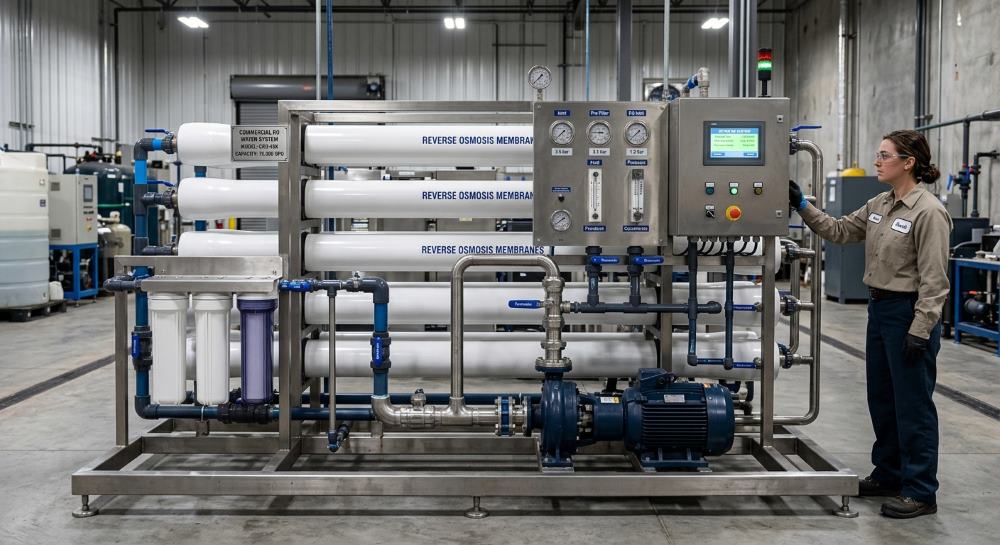
Davis Water Conditioning provides commercial reverse osmosis systems for commercial and light-industrial applications. We have capacities from approximately 500 to 5,000 gallons per day, with systems available for both municipal and well-water supplies.
Commercial RO can be relevant for businesses such as wineries, restaurants, hotels and other operations where water quality and consistent supply matter. The system needs to be matched to the property’s water conditions and daily demand rather than selected solely by the size of the building.
What About Well Water?
Reverse osmosis can be used with well water, but private wells can have significantly different water conditions from one property to another.
If you are considering RO for a well, it is important to understand what is in the incoming water first. Depending on the results, pre-treatment may be necessary before the RO system so the membrane and other components are not exposed to conditions they were not intended to handle.
We also provide other well-water treatment options, including whole-house filtration and ozone systems, so RO does not have to be treated as the answer to every well-water problem.
RO Filter Replacement And Maintenance
Reverse osmosis systems rely on filters and membrane to perform properly, so replacing those components on schedule is part of owning the system.
For the 3M RO 301, 3M recommends replacing the pre- and post-filters at least every 12 months and the membrane module at least every 36 months, with actual filter life depending on water quality and usage.
Davis Water Conditioning provides RO service and replacement filters and also offers maintenance contracts for systems that require regular filter changes or other scheduled service.
Do You Need Reverse Osmosis?
Not every water-quality concern calls for RO.
If the main issue is hard water throughout the property, a water softener may be more appropriate. If you are dealing with broader whole-house filtration needs, a point-of-entry filtration system may make more sense.
Reverse osmosis is most useful when you want targeted, higher-level treatment for water used for drinking and cooking. Testing the water and understanding the actual problem can help determine whether RO belongs in your treatment setup.
Local Water Treatment From Davis Water Conditioning
Local Water Treatment From Davis Water Conditioning
Davis Water Conditioning has more than 30 years of experience working with residential and commercial water treatment in San Luis Obispo County.
Based in Paso Robles, we work with different water sources, properties and treatment needs. We evaluate your water and explain the available options. After that, we handle installation and ongoing service.
If you’re considering reverse osmosis for your home or business, you don’t need to figure out which system you need before you call us.
Get Better Drinking Water At The Tap
If you’re concerned about the quality, taste or composition of your drinking water, Davis Water Conditioning helps you determine whether reverse osmosis is the right approach.
Areas We Serve
Water Treatment Throughout San Luis Obispo County
Davis Water Conditioning is based in Paso Robles and serves homeowners and businesses across San Luis Obispo County with water testing, treatment systems and service for existing equipment.
Paso Robles
Water treatment in Paso Robles
Templeton
Water treatment in Templeton
Atascadero
Water treatment in Atascadero
San Luis Obispo
Water treatment in San Luis Obispo
Morro Bay & Cayucos
Water treatment in Morro Bay
Pismo Beach, Grover Beach & Arroyo Grande
Water treatment in Pismo Beach
Los Osos
Water treatment in Los Osos
San Miguel & Shandon
Water treatment in San Miguel
Frequently Asked Questions (FAQs)
Does reverse osmosis remove hardness?
RO can reduce dissolved minerals that contribute to hardness, but it is generally not used as a replacement for whole-house water softening.
Does reverse osmosis remove chlorine?
Many RO systems use carbon filtration as part of the treatment process to reduce chlorine taste and odor. The exact reduction depends on the specific system and its certified performance.
Does reverse osmosis waste water?
Some water is discharged during the RO process rather than becoming treated water. The amount varies by system, water pressure, temperature and other operating conditions.
Does reverse osmosis need electricity?
Not every residential RO system requires electricity. The 3M RO 301, for example, operates using normal water-line pressure without an electrical power source.
How often do reverse osmosis filters need to be replaced?
Replacement schedules depend on the system, water quality, usage, etc. It’s recommended at least every 12 months, while the membrane is recommended for replacement at least every 36 months.